Meta-prompting skills: Learn any skill with AI guide

- Learn how to use AI to learn anything, from coding to playing instruments.
- Follow a clear prompting technique that adapts to your learning style.
- Build your own custom AI tutor in under 10 minutes.
What if you had free, step-by-step guidance from AI to learn any skill?
You’re staring at a YouTube tutorial, rewinding for the fifth time. Or maybe you’ve bought a course, but it’s not interactive enough for you, so you get bored after 20 minutes. What if learning felt more like a conversation, with someone who actually understands how you learn?
That’s where meta prompting comes in. It’s a smart way to get large language models like ChatGPT to actually work with you, not just for you. Basically, you give your AI a kind of teaching game plan, then tweak it until it clicks with how you learn best.
This guide will show you how to use meta prompting to pick up any new skill. No need to know how to code, understand learning theory, or mess with complicated tools.
What is meta prompting?
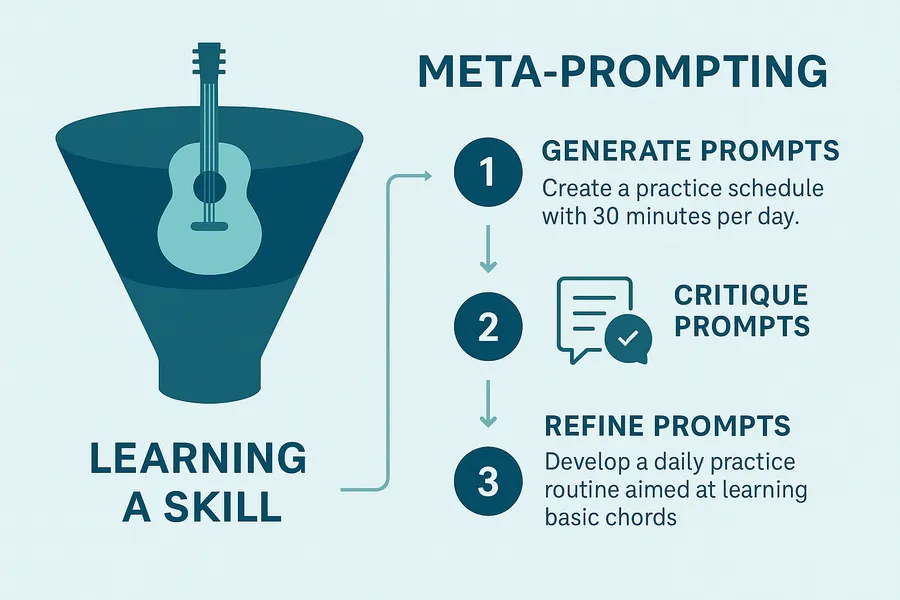
Meta prompting means asking the AI how to ask better questions. Instead of just saying “teach me to play piano,” you’re saying: “What’s the best way to teach someone like me to learn piano step by step?”
You’re prompting the AI to design a learning plan, explain concepts at the right depth, check your understanding, and adjust based on feedback. It’s learning how to learn, with help.
Step 1: Define your learning goal clearly
Start with something specific:
- Bad: “I want to learn photography.”
- Better: “I want to learn how to shoot sharp portrait photos in natural light using a DSLR.” Then meta-prompt with this:
        I want to learn [insert goal].
Act as a learning strategist. Help me define the exact sub-skills I should master, in order, and suggest how I can track my progress.
Example:
        I want to learn how to play jazz piano.
Act as a learning strategist. What sub-skills do I need, and how can I measure my improvement?
Step 2: Choose your learning style
Do you learn best by doing? Reading? Explaining things back? Ask the AI to teach in a way that suits you:
        I learn best by doing hands-on exercises and getting feedback.
Teach me [skill] using that approach.
Bonus meta-prompt:
Ask me 3 questions to understand how I learn best, then design a custom learning approach based on my answers.
Step 3: Create your AI tutor petrsona
Give your AI a role, tone, and teaching method:
        You’re now a patient math tutor who explains things visually and never assumes prior knowledge.
Use lots of examples.
Or go meta:
Based on my goal and learning style, what kind of tutor should you be to help me learn this skill fastest?
Then save that persona as a system prompt or pinned chat.
Step 4: Set up interactive practice
Prompt the AI to test you and offer feedback:
        Quiz me on the last thing we covered, using multiple choice and open-ended questions.
Explain the answers afterward.
Or:
Give me a practice scenario, watch how I solve it, and coach me like a mentor.
Meta version:
What are effective ways to test my understanding of this concept interactively, with your help?
Step 5: Reflect and recalibrate
Every few sessions, check in with the AI:
How well am I progressing based on our past chats? What should I revisit or dive deeper into?
And improve your prompt style:
How can I ask you better questions to get more helpful learning support?
Example: Learning to draw portraits
Let’s say you want to learn to draw realistic portraits. Your prompting flow might look like this:
- Meta prompt: “I want to learn to draw realistic portraits. What sub-skills do I need, and how should I structure my practice?”
- Style check: “I learn best with visuals and trying things out. Adjust the plan to fit that.”
- Tutor persona: “Be an encouraging art teacher who gives visual examples and tips after each sketch I share.”
- Interactive session: “Give me a face to sketch and feedback on my proportions.”
- Recalibrate: “Which of my sketches shows the most improvement, and what’s next?”
Bonus: Chain your prompts
Prompt chaining means building one smart prompt from another. Start simple:
What are the 3 best ways to learn [skill] for beginners?
Then follow up with:
Pick one and walk me through a daily plan using that method.
Then:
Now act as a tutor using this plan and quiz me each day.
Stack smartly, and you’ll build a fully customized AI learning assistant.
The bottom line
Meta prompting turns LLMs from know-it-alls into know-you-wells. Instead of generic advice, you get tailored teaching that grows with you.
It’s not magic. It’s just smart prompting, and it can seriously speed up how you master new skills.
Now go try it. One smart question at a time.